1 stage, 1 place to sleep
Open a stage to see what you pass and where to stay that night.
Planning the Hel Peninsula Separate Cycleway — the practical guide
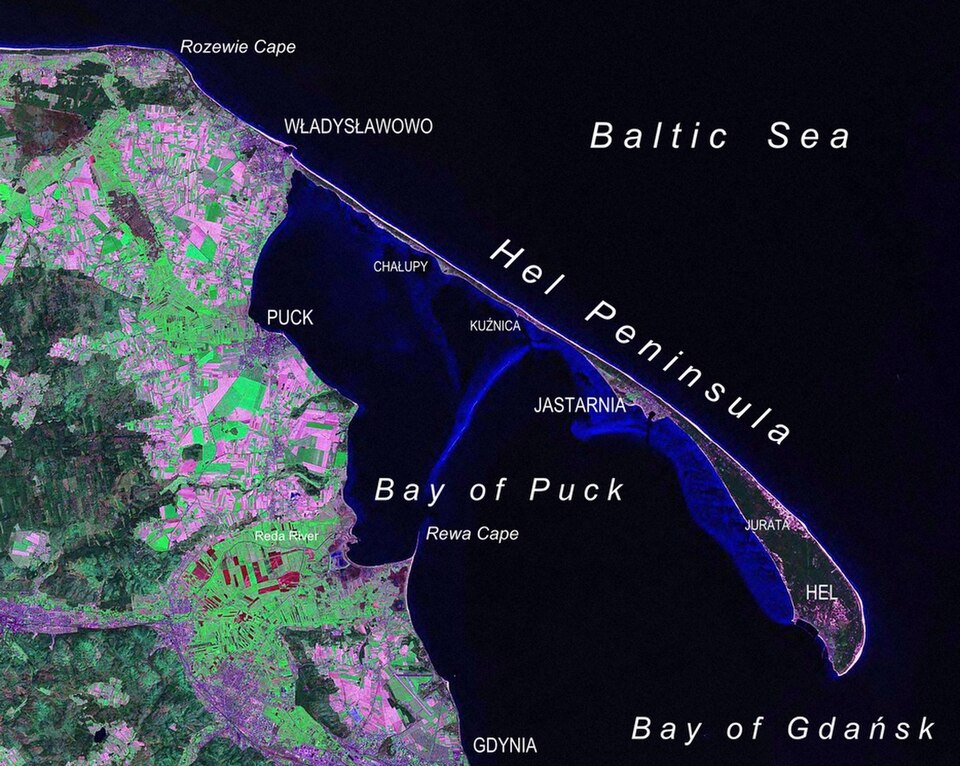
The Hel Peninsula Separate Cycleway covers 45 km from Władysławowo to Hel in a single stage. It is designed as one committed day — start early and let the terminus town absorb the evening. You ride it in the order written, but every stage town works as an entry or exit point, so the route sections cleanly for shorter trips.
Overnights run Hel — each bookable from the stage cards above. Book the smallest stops first: a village with a handful of guesthouses sells out weeks before a resort with fifty.
Planning & pacing
Pomerania has quietly built some of Europe's best cycling infrastructure: the coastal EuroVelo 10 corridor now runs largely on separated asphalt and hard gravel, the Hel peninsula has a dedicated car-free path down its whole length, and inland networks like the Kaszubska Marszruta were engineered specifically for bikes. Stage lengths here assume a touring pace of 15–18 km/h with stops; strong riders can double stages, and e-bikes flatten the Kashubian moraine entirely.
Surfaces are the planning variable: coastal greenways are asphalt, the lake-belt routes mix crushed limestone and forest gravel (35 mm tyres or wider are happiest), and short beach-town connections occasionally use cobbles. Nothing on these routes needs a mountain bike; everything is rideable on a hybrid or gravel bike.
Wind is the terrain of the Baltic coast: the prevailing westerly makes west-to-east the fast direction on shore-parallel routes. Check the forecast and be willing to ride a route 'backwards' — the stage towns work in either order, and every overnight stop has beds bookable through the buttons above.
When to go
May, June and September are perfect riding: 15–22°C, low rain, empty paths and shoulder-season hotel rates in every stage town. July and August work well on the separated paths (traffic can't touch you) but the resort sections get pedestrian-busy midday — ride early, swim at noon, ride at five.
April and October are underrated on the asphalt routes with the right clothing; the gravel networks drain well but forest sections stay damp. Winter riding is for the committed — the coast path is plowed nowhere and the wind is serious.
What to pack
Panniers beat backpacks on multi-day stages — the wind punishes a high centre of gravity. Carry a basic kit (tube, levers, pump, multitool); bike shops cluster in the Tricity, Łeba and Kołobrzeg but thin out between. Helmets aren't legally required for adults in Poland but the separated paths make them an easy habit.
Lights are non-negotiable in shoulder season (forest sections go dark early) and a phone mount pays for itself — the waymarked networks are good, but junctions in the pine barrens all look alike.
Transport & logistics
Trains are the cyclist's secret weapon here: SKM and regional services carry bikes for a small supplement (free on some), which makes one-way rides with a rail return the standard local pattern. July peninsula trains fill with bikes by mid-morning — board early or book the water tram, which also takes bikes.
Rental works for entire tours, not just day rides: the coastal networks offer trekking bikes and e-bikes with one-way drops between their hubs, so you can ride Świnoujście→Gdańsk without ever owning a wheel here. Reserve one-ways at least a few days ahead in season.
Eating along the route
Cycling appetite meets its match here. The coast path serves a fish hut or waffle stand every few kilometres in season, stage towns all have proper supermarkets for pannier restocking, and the smokehouse lunch — warm halibut, bread, pickle, sea wall — is the finest mid-ride meal in Northern Europe at 30 zł. Inland, the karczma taverns by the lake routes plate Kashubian goose and potato dumplings in quantities that assume you rode there.
Carry real food on the forest networks (the pine barrens between villages are shop-free for 20–30 km stretches) and treat the region's bakery culture as ride fuel: drożdżówka pastries and dark rye keep better in a jersey pocket than anything from a gel wrapper.
Safety & local rules
The separated infrastructure removes most cycling risk — on the coastal greenways and forest networks you simply never meet a car. Where routes touch roads, Polish law requires drivers to give 1 m when overtaking, and rural drivers are used to bikes. The real hazards are self-inflicted: sand drifted across the path near dunes (it steers like ice), pedestrian swarms in resort centres at noon, and Baltic crosswinds that shove loaded bikes around on exposed dike sections.
Helmets are not legally required for adults but wise at greenway speeds. Lock quality matters in the Tricity as in any city; village Poland barely requires it. Emergency 112 works everywhere, and the rail network doubles as your mechanical-failure recovery system — no stage on these routes is far from a station or bus stop.